Commercial Floor Sanding in Mitcham, CR4
Commercial timber floors in Mitcham take a fair amount of punishment. Office chairs wear through lacquer, restaurant cleaning chemicals attack old seals, and grit carried into shops cuts fine scratches across entrances and walkways. Once the protective coating fails, moisture and dirt begin working into the timber, turning what started as a cosmetic problem into a maintenance and safety concern.
At Floor Sanding Mitcham, we restore wooden floors in offices, shops, restaurants, schools, community buildings and other working premises. Whether you manage a Victorian conversion near Mitcham Cricket Green, a retail unit on London Road or a commercial property serving the wider South London area, the job needs planning around your building, your staff and your opening hours. Our Commercial Floor Restoration in Mitcham service covers timber repairs, controlled sanding and protective finishing rather than simply applying another coat over an already failing surface.
Some floors need stripping back to clean timber; others can be maintained without a full sanding programme. We assess the existing coating, timber thickness and traffic before recommending Commercial Floor maintenance in Mitcham or Commercial Floor Polishing in Mitcham. The aim is a durable, fit-for-purpose floor with a sensible return-to-service schedule, not an unnecessarily expensive restoration.

Commercial floor sanding in Mitcham – before and after comparison showing the transformation of worn herringbone parquet flooring into a beautifully restored, glossy timber floor in a community hall.
Commercial Timber Floors: Structural Wear, Slip Risks and Daily Traffic
Commercial flooring cannot be approached in quite the same way as a spare bedroom. A café may have moisture and detergent collecting beside the serving counter, while a serviced office has constant chair movement across the same narrow sections of floor. In a school hall or place of worship, footwear, cleaning routines and the number of people using the space can change considerably throughout the week.
Domestic-grade polish often makes these problems worse. It may leave an uneven sheen, interfere with the adhesion of a future lacquer or produce a slippery residue when the floor is damp. A proper assessment establishes whether the surface requires cleaning, abrasion and recoating, or complete sanding and repairs.
Common Problems We Look For
- Open board joints: Gaps collect grit, food debris and cleaning moisture, creating hygiene problems in cafés, treatment rooms and busy public buildings.
- Loose parquet blocks: Failed adhesive allows timber to move under foot traffic and furniture, with raised edges becoming a potential trip hazard.
- Worn lacquer: Once the protective film disappears, grease, water and cleaning agents can mark the exposed timber.
- Uneven slip resistance: Polished entrances, contaminated surfaces and worn finishes may require a formal slip-risk assessment.
- Subfloor moisture: Damp concrete or excessive moisture in suspended floors can contribute to cupping, movement and adhesive failure.
- Heavy point loading: Trolleys, equipment, exercise machines and mobile storage can damage boards or parquet not designed for those loads.
Slip resistance needs particular attention in entrances, hospitality areas, public corridors and healthcare premises. Where testing is justified, the pendulum method associated with BS 7976-2 provides a recognised means of assessing surface slip potential. A wet pendulum test value of 36 or above is generally associated with low slip potential, but the appropriate assessment must reflect actual conditions, contamination, footwear and use.
Commercial Floor Restoration for Mitcham Businesses and Public Buildings
Mitcham contains a mixture of older commercial premises, converted properties, retail parades, modern workspaces and community buildings. Around Cricket Green and Church Road, older building fabric calls for particular care; along London Road and near Mitcham Junction, access, deliveries and trading hours often dictate how work is organised.
Offices, Coworking Spaces and Serviced Offices
We assess wear beneath desk chairs, reception counters, meeting tables and circulation routes. Work can be divided between office zones so that furniture, IT equipment and staff access are managed in an agreed sequence. Floor protection and cleaning guidance are particularly important beneath wheeled chairs.
Shops, Boutiques, Showrooms and Shopping-Centre Units
Shop entrances suffer abrasion from street grit and wet footwear, while display fixtures create concentrated loads. We account for stock movement, shutters, landlord access requirements and trading deadlines before scheduling sanding and coating. A sensible overnight programme still needs enough protected curing time before customers return.
Restaurants, Cafés, Pubs and Takeaway Premises
Food spills, grease, chair movement and repeated mopping are hard on timber finishes. Particular attention is given to joints, perimeter details and the condition of the floor around serving and dining areas. Timber may not be suitable for every wet preparation zone, and the correct finish depends on the site’s hygiene and slip-control requirements.
Factories, Workshops, Warehouses and Distribution Premises
Traditional timber floors in older workshops, manufacturing units, storage buildings and delivery depots may have localised wear from trolleys, racking and machinery. Before sanding, we check board stability, loading, contamination and whether the floor is suitable for continued commercial use. Restoration is not a substitute for structural repairs or an engineered industrial flooring system where heavy loads demand one.
Gyms, Cinemas, Studios and Event Venues
Timber in studios and event spaces must withstand repeated footfall, furniture movement and equipment installation. Dance and sports floors also have specific friction, resilience and maintenance requirements. Finishes should be selected against the intended activity rather than appearance alone.
Hotels, Hostels and Serviced Accommodation
Guest corridors, reception areas and shared rooms need carefully controlled access during refurbishment. Sectional sanding can help keep unaffected parts of a building operating, provided ventilation, fire escape routes and safe separation remain in place. Furniture replacement and guest access are scheduled against the coating manufacturer’s curing instructions.
Clinics, Dental Practices and Treatment Rooms
Clinical environments require particular attention to cleanability, contamination and cleaning chemicals. We establish whether the existing timber floor can meet the site’s infection prevention and cleaning requirements before recommending restoration. Low-emission coatings may be appropriate, but timber is not automatically suitable for every clinical room.
Schools, Colleges, Universities and Academies
School halls, classrooms, libraries and institutional corridors often contain older strip flooring or parquet that has been sanded several times. We check remaining timber thickness, loose blocks and previous repairs before specifying the work. Half-term, holiday and weekend programmes are often more practical than attempting a rushed weekday turnaround.
Churches, Mosques, Temples and Community Halls
Places of worship may have historic timber, heavy fixed furniture and areas used barefoot or during regular gatherings. We assess existing finishes, joint movement and any heritage constraints, then plan work around services, prayers and community bookings. Barefoot slip performance can require different testing considerations from ordinary shod pedestrian areas.
Our Commercial Wood Floor Sanding and Restoration Process
Step 1: Subfloor Audit, Timber Identification and Moisture Testing
Before machinery is brought onto the floor, we establish what is actually underfoot. An older Mitcham building may contain pitch pine boards fixed over joists, quartersawn oak blocks laid in parquet patterns or later hardwood flooring over a concrete base. Teak and other dense hardwoods require different preparation and finishing considerations from softer pine.
We inspect previous sanding depth, loose fixings, damaged tongues, movement and the adhesion of existing coatings. Timber moisture readings are considered alongside the room’s temperature and relative humidity. Where the floor is bonded to concrete, calibrated hygrometer checks or other appropriate substrate testing help establish whether moisture conditions are suitable for repair and finishing. If dampness is actively entering the construction, applying a new coating will not correct it. The source has to be investigated before restoration proceeds.
Step 2: Timber Repairs, Parquet Re-Bonding and Resin Gap-Filling
Loose boards are secured where the underlying construction allows it. Damaged sections can be replaced with compatible timber, taking account of species, dimensions, grain direction and the appearance of the surrounding floor. On an older pitch pine floor, forcing in unsuitable new boards can produce an obvious repair and unnecessary movement.
For loose parquet, a compatible silane-based flexible parquet adhesive may be specified after the substrate and old adhesive have been assessed. It can accommodate limited natural movement, but the adhesive must suit the timber and subfloor. Older bituminous residues and unidentified historic materials require appropriate investigation before disturbance. Small, stable gaps can be treated with resin-slurry filling using fine, compatible sanding dust and an appropriate binder. Larger openings may require timber slivers or individual repairs. We do not rigidly fill active expansion joints or promise that seasonal board movement will disappear permanently.
Step 3: Lägler Hummel Sanding and HEPA Dust-Controlled Preparation
For substantial strip timber floors, the Lägler Hummel belt sander is a proven trade machine, capable of removing failed coatings and levelling uneven wear when operated correctly. The abrasive sequence is selected according to the timber and existing condition, with edges, corners and areas around fixed fittings treated separately. Parquet requires particular care to avoid sanding patterns that exaggerate changes in grain direction.
Commercial dust control needs more than an ordinary vacuum cleaner. Our proposed method includes on-tool extraction, suitable filtration and consideration of HEPA H14 extraction where the equipment and site risk assessment require it. H14 filtration alone does not guarantee that airborne dust is controlled: machine capture efficiency, enclosure, cleaning methods and operator protection all matter. Wood dust exposure is covered by the Control of Substances Hazardous to Health Regulations. We consider appropriate respiratory protective equipment, suitable extraction and cleaning arrangements within the COSHH assessment and Risk Assessment and Method Statement (RAMS). Adjacent occupied rooms may need physical segregation, with air movement and ventilation considered before work begins.

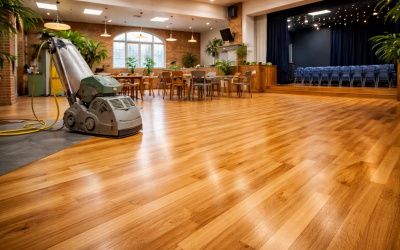
Professional commercial floor sanding in Mitcham, restoring parquet and hardwood floors to a smooth, beautiful finish.
Step 4: High-Traffic Lacquers, Hardwax Oils and Slip-Resistant Finishes
Once sanding is complete, the finish must suit the timber and its intended use. For busy offices, retail floors and many public circulation spaces, a properly specified two-component waterborne polyurethane lacquer can provide strong resistance to abrasion and routine cleaning. These 2K systems use a measured cross-linking catalyst or hardener, and the manufacturer’s mixing ratio and usable pot life must be followed precisely.
The surface must be sufficiently clean, and primers, intermediate abrasion and subsequent coats must comply with the chosen coating system. Incorrect catalyst ratios, contamination or recoating outside the permitted window can cause adhesion and curing problems. A thicker coating is not necessarily a better coating. Commercial hardwax oils can be appropriate where localised maintenance is a priority and the cleaning regime is compatible. They should not automatically be substituted for high-performance lacquer in areas exposed to frequent water, grease or aggressive detergents.
Where enhanced slip resistance is required, we assess specialist finishes or compatible anti-slip additives against the intended application. A textured coating does not remove the need for cleaning and contamination control. Product slip-test evidence should be relevant to the actual installed system, and site testing may be necessary. For occupied offices, schools and healthcare-related environments, low-emission products may be preferable. We can consider coatings and adhesives carrying recognised emissions classifications such as EMICODE EC1 Plus, where the particular product holds that rating. EC1 Plus relates to emissions testing; it is not a substitute for COSHH controls or proper ventilation during application.
Step 5: Curing, Handover and Commercial Maintenance Protocols
A floor that feels dry is not necessarily fully cured. Depending on the product, temperature, humidity and ventilation, carefully controlled light pedestrian access may sometimes be possible after approximately 12–24 hours, while full chemical and mechanical resistance may take several days or longer. The actual reoccupation programme is governed by the selected manufacturer’s technical data sheet.
We advise when furniture can be returned, when heavy equipment can be moved and when routine damp cleaning may resume. Desk chairs should have suitable castors or protective mats, and entrance matting must be maintained to prevent grit reaching the finished timber. For ongoing maintenance, use compatible, pH-appropriate cleaning products and avoid excessive water. Periodic inspections can identify thinning lacquer, exposed joints and localised damage before another complete sanding becomes necessary.
Out-of-Hours Commercial Floor Sanding Without Unnecessary Closure
Managing the timetable is often as important as selecting the lacquer. A shop may need its doors open at nine, a clinic may have appointments booked weeks ahead, and an office may have security-controlled access after six. We plan machinery deliveries, waste removal, extraction, coating and curing around the way the premises operates.
| Working Shift | Operational Benefit | Suitable Premises |
|---|---|---|
| Overnight | Separates noisy preparation work from normal trading hours. Reopening remains subject to coating cure times. | Shops, offices, restaurants, showrooms and reception areas. |
| Weekend Phased | Provides a longer uninterrupted working window for sanding, coating and initial curing. | Schools, colleges, clinics, offices and community buildings. |
| Sectional | Allows agreed parts of a property to remain operational behind suitable barriers while other areas are restored. | Hotels, coworking spaces, studios, large offices and multi-room premises. |
Sectional work is not always practical. Connecting corridors, fire exits, dust migration, ventilation and the location of the final coating edge all need checking. Overnight sanding also has to account for neighbouring occupiers, permitted working hours and any restrictions imposed by the landlord or building management.
We discuss electrical supply, loading access, parking, storage, alarm systems and contractor sign-in arrangements before agreeing the programme. Where several trades are working on the same refurbishment, sanding and finishing should be positioned in the programme to prevent fresh coatings being damaged by subsequent building work.

Commercial Floor Sanding Around Mitcham and South London
Mitcham’s older buildings are not all constructed alike. The streets around Cricket Green include historic properties with traditional timber detailing, while the town centre has Victorian commercial frontages and later alterations. In converted premises, we pay attention to older subfloors, uneven joists, previous repairs and the amount of timber remaining above board tongues and parquet joints.
Premises near Mitcham Junction, Figges Marsh, London Road and the wider CR4 district bring different practical considerations, from loading restrictions to tenant access and evening trading. We also consider enquiries from businesses operating in SE1, including offices and hospitality premises around Southwark and Waterloo.
Buildings within or near the Mitcham Cricket Green Conservation Area may have additional heritage considerations. Where listed fabric or historically significant flooring is involved, the proposed repair method and any necessary permissions should be checked before material is removed.
Our approach is to preserve serviceable original timber wherever practical. Replacing an entire floor when the damage is limited to failed coating, loose blocks or individual boards is often unnecessary, provided the structure and remaining timber are sound.
Commercial Floor Sanding Prices and Site Quotations
Commercial floor sanding costs depend on more than square metres. Timber condition, previous coatings, repair quantities, required finish, access restrictions and the number of separate working phases all affect the labour and material allowance. A clear open-plan floor is considerably different from a working restaurant full of fixed seating and service counters.
You can review our published floor sanding prices in Mitcham for indicative rates. For larger commercial projects, a site-specific quotation is more useful because it identifies preparation, repairs, coating specifications, access arrangements and any agreed out-of-hours work.
What We Need to Prepare an Accurate Estimate
- Approximate floor area in square metres and a basic floor plan, if available.
- Clear photographs showing general condition, entrances, damaged joints and worn areas.
- Details of the premises, timber type if known, and existing coating.
- Normal opening hours, delivery access and preferred refurbishment dates.
- Any special requirements for slip resistance, low-emission products or contractor documentation.
Photographs or a short video are useful for an initial assessment. Where structural damage, moisture, adhesion failure or complex access is involved, a physical site survey is needed before the scope and price can be confirmed.
For examples of floor finishes and restoration work, visit our wood floor sanding gallery. The photographs can also help you explain the appearance you want, whether that is natural matt oak, traditionally finished pine or a more contemporary lacquered surface.
Commercial Site Safety, Documentation and Quality Control
A commercial flooring contractor should be prepared to work within a building’s health and safety procedures, not around them. Before appointment, site management can request confirmation of public and employers’ liability insurance, relevant CSCS cards for personnel where required, and suitable evidence of competence for the work.
For sites requiring formal contractor documentation, the proposed arrangements should include task-specific RAMS, COSHH assessments and relevant coating safety data sheets. Dust control, pedestrian segregation, emergency access, electrical safety, chemical storage and ventilation must be addressed in the working method.
Product selection and surface preparation should be recorded clearly enough for the facilities manager to understand what has been applied and how it must be maintained. Where slip testing is specified, results should be documented by a competent tester using the appropriate recognised method.
Our quotation process is intended to make the scope clear before work starts: what requires repair, which finish is proposed, what access is needed and when the treated areas may be put back into use. Insurance documents, workforce credentials and project-specific compliance requirements should be confirmed during procurement rather than assumed from a website description.
Frequently Asked Questions About Commercial Floor Sanding
Can a commercial wooden floor be sanded overnight?
In many circumstances, yes, provided access, noise restrictions, extraction and safe working arrangements allow it. Sanding and coating are separate stages, however, and an overnight shift does not automatically mean the premises can reopen the following morning.
How long does commercial floor lacquer take to cure?
It depends on the chosen product and site conditions. Some systems permit carefully controlled light foot traffic within roughly 12–24 hours, but furniture, heavy loading, wet cleaning and full chemical exposure may need to be delayed for several days. We work to the manufacturer’s written cure guidance.
Do offices and shops always need complete floor sanding?
No. Where the original finish remains sound and compatible, a professional clean, preparation and maintenance coat may be possible. If the coating has worn through to bare timber or is peeling, complete sanding is generally the more reliable option.
Can old school parquet flooring be restored?
Often it can, provided the blocks have adequate remaining thickness and the substrate is stable. Loose parquet, damaged joints and historic adhesives need assessing before sanding. Extensive adhesive failure or moisture damage can make more substantial repairs necessary.
Can you provide a slip-resistant finish for a restaurant or public building?
Suitable coatings and additives can be considered, but their selection depends on the activities, cleaning practices and expected contamination. Where a particular slip-resistance performance is required, the specification should be supported by appropriate testing and site-specific risk assessment.
Will dust extraction allow our staff to remain in the building?
Possibly in unaffected, properly separated areas, but this must be decided through the risk assessment. Extraction substantially reduces airborne dust when correctly designed and operated; it does not eliminate exposure. Some areas may need to be vacated temporarily.